
By the SLA Team
Across the country, school leaders are confronting a familiar but intensifying reality: budget freezes, delayed allocations, and cuts that arrive just as needs are growing. Federal relief funds have expired, state revenues remain uneven, and districts are being asked to maintain — or improve — outcomes with fewer dollars. For superintendents, principals, and central office leaders, the challenge is no longer simply how to stretch a budget, but how to strategically redesign how resources are used so that schools remain effective, compliant, and focused on student success.
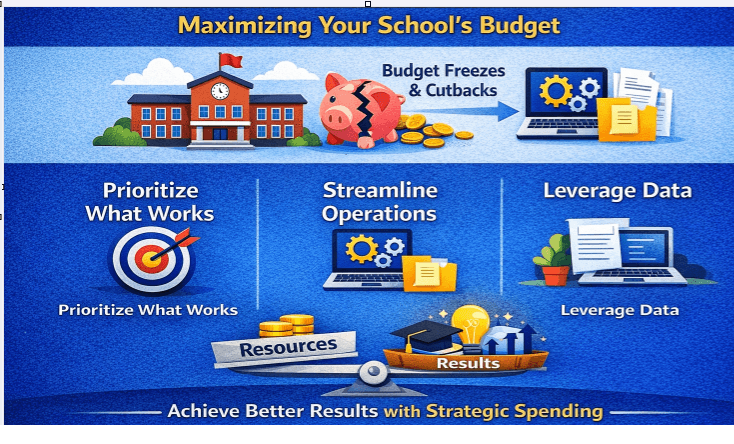
The most successful leaders in this moment are not reacting with across-the-board cuts alone. Instead, they are rethinking priorities, aligning spending with evidence, and using smarter tools and processes to ensure every dollar advances a clear instructional or operational goal.
One of the first shifts we’re seeing is a move away from incremental budgeting toward intentional alignment. When budgets are tight, legacy programs and automatic renewals can quietly consume resources without delivering measurable impact. High-performing districts are stepping back to ask hard questions: Which initiatives are directly tied to student learning, staff retention, or compliance requirements? Which ones persist mainly because “we’ve always done it this way”? This kind of alignment exercise often reveals that small reallocations — not massive cuts — can free up meaningful resources.
For example, leaders in large urban systems like Chicago Public Schools have publicly emphasized targeted investments in high-impact strategies, even during periods of financial constraint. Rather than spreading limited funds thinly across dozens of initiatives, they prioritized literacy supports, data-driven intervention models, and leadership development tied to measurable outcomes. The lesson is clear: focus matters more than scale when resources are limited.
Another powerful lever is reducing inefficiency in administrative work. School leaders routinely spend hours locating documents, cross-referencing plans, responding to compliance requests, or recreating reports that already exist in some form. While these tasks are necessary, they rarely improve student outcomes — and they are costly in terms of staff time. Districts that have invested in centralized systems for planning, documentation, and progress tracking often report significant savings, not because they cut staff, but because they reduced duplication and manual work.
A frequently cited example comes from districts within the New York City Department of Education, where schools using standardized planning frameworks and shared digital tools have been able to streamline school improvement planning and monitoring. This has allowed administrators to redirect time and energy toward coaching teachers, engaging families, and addressing student needs — all without increasing expenditures.
Doing more with less also requires using data as a budgeting tool, not just an accountability measure. When leaders can clearly see which programs are producing results — and which are not — budget conversations become less political and more strategic. Data-informed budgeting allows schools to defend effective programs during cuts while making the case to pause or redesign initiatives that are underperforming. Importantly, this approach builds trust with boards, staff, and communities by showing that decisions are grounded in evidence rather than convenience.
Equally important is investing in leadership capacity, even when funds are tight. At first glance, leadership tools or professional learning may seem expendable during a budget freeze. In practice, they are often the difference between reactive cuts and strategic stewardship. Strong leaders equipped with clear standards, aligned plans, and real-time feedback are far more likely to navigate fiscal constraints successfully. They are also better positioned to retain staff, which itself is a major cost-savings strategy given the expense of turnover and recruitment.
We’re also seeing schools leverage technology not as an add-on, but as a force multiplier. The most effective tools are not flashy or experimental; they are practical, standards-aligned, and designed to support existing workflows. When technology helps leaders answer questions faster, align actions to goals, and monitor progress without additional reporting burdens, it becomes a cost-control strategy rather than a budget line item to defend.
Ultimately, maximizing a school’s budget in today’s environment is about clarity and coherence. Clarity about what matters most, coherence between plans and spending, and discipline in saying no to initiatives that dilute focus. Budget freezes and cutbacks are undeniably challenging, but they also create an opportunity to strip away inefficiency and sharpen impact.
School leaders have always been stewards of limited resources. What’s different now is the urgency — and the availability of better tools and frameworks to support smarter decisions. By aligning resources to priorities, reducing administrative drag, using data strategically, and investing in leadership capacity, schools can do more with less — and do it well.
At School Leader’s Advantage (SLA), we believe that thoughtful alignment and evidence-based decision-making are not luxuries reserved for well-funded districts. They are essential strategies for every school navigating today’s fiscal realities — and powerful pathways to sustaining excellence, even in lean times.
School Leader’s Advantage (SLA) offers a Solution Bot and evidence-based resources that can help K-12 educational administrators make the most of their building's allocative, categorical, and grant funding. Sign up for a free trial today at https://schoolleadersadvantage.com.
#Schoolfunding #Schoolbudgets #Schoolfinancing