By the SLA Editorial Team
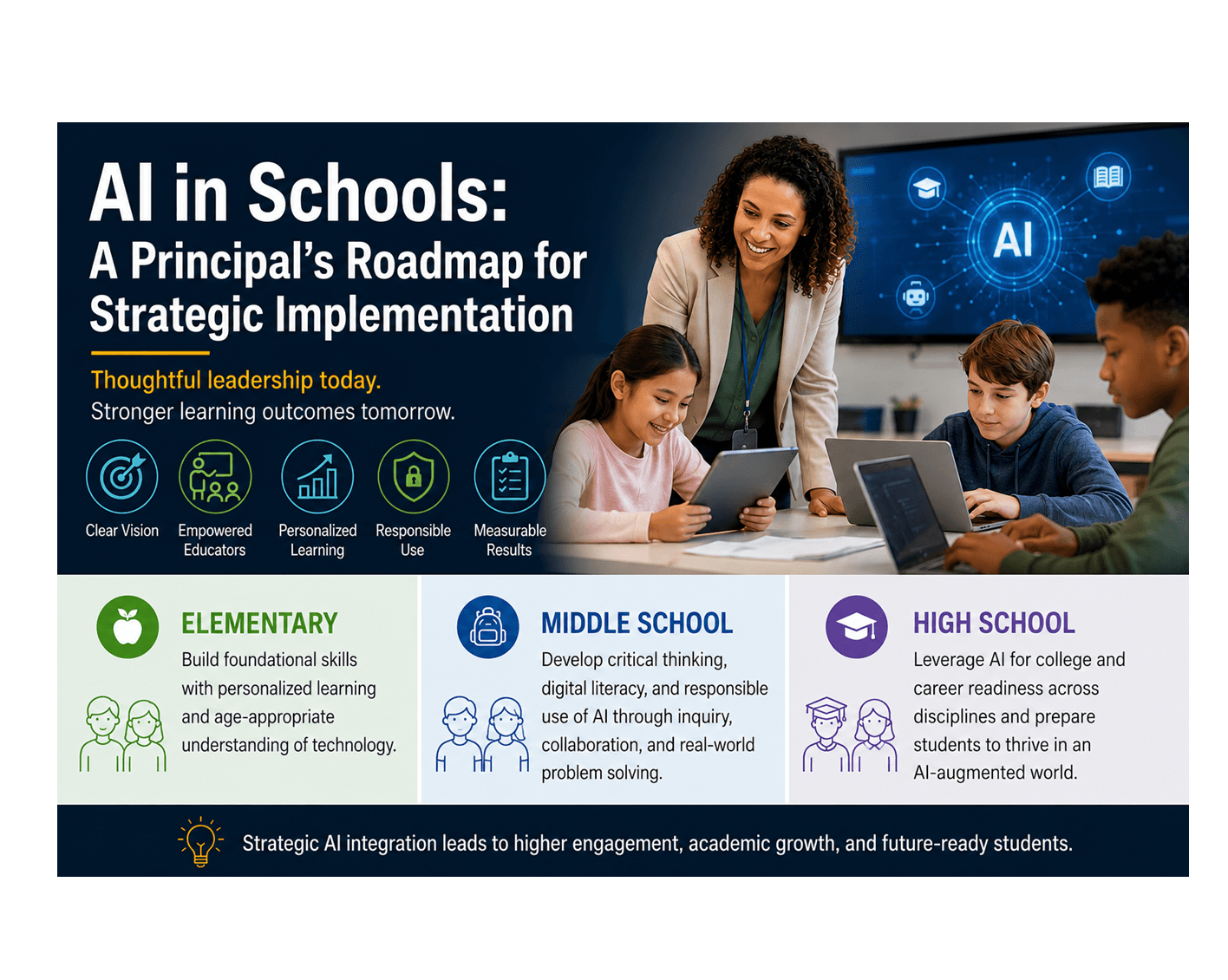
Artificial Intelligence is rapidly transforming education, but successful implementation requires more than simply introducing new technology. School leaders must develop a thoughtful, strategic plan that aligns AI initiatives with instructional goals, student needs, and community expectations.
The most effective AI strategies begin with a simple question:How can AI improve teaching and learning outcomes for students?
Start with a Vision, Not a Tool
Before selecting platforms or applications, principals should establish a clear vision for AI integration. This vision should focus on enhancing student achievement, supporting teachers, personalizing learning, and preparing students for an increasingly AI-driven workforce.
A strategic plan should address professional development, curriculum integration, digital citizenship, data privacy, and ongoing evaluation of outcomes.
Elementary Schools: Building Foundations
At the elementary level, AI should primarily support foundational skills and personalized learning.
Principals can encourage teachers to leverage AI-powered adaptive learning platforms that adjust instruction based on individual student needs. These tools can provide targeted practice in reading and mathematics while allowing teachers to identify learning gaps more quickly.
Equally important is introducing students to age-appropriate concepts about technology, responsible use, and critical thinking. The goal is not to make young children AI experts, but rather to help them become thoughtful consumers and users of technology.
Middle Schools: Developing Critical Thinkers
Middle school students are naturally curious and increasingly independent learners, making this an ideal stage for deeper AI integration.
Principals should focus on helping teachers incorporate AI into research, writing, project-based learning, and problem-solving activities. Students can learn how AI generates information, evaluate its accuracy, identify potential bias, and compare AI-generated responses with credible sources.
This stage is particularly important for developing digital literacy skills. Students should understand both the opportunities and limitations of AI while learning to think critically rather than relying solely on automated answers.
High Schools: Preparing Future-Ready Graduates
High schools have the greatest opportunity to leverage AI as a tool for college, career, and workforce readiness.
Strategic plans should encourage the integration of AI across disciplines, including STEM, business, humanities, career and technical education, and the arts. Students can use AI to support research, data analysis, coding, content creation, and entrepreneurial projects.
School leaders should also consider offering specialized coursework focused on AI, machine learning, ethics, and emerging technologies. Graduates who understand how to work effectively alongside AI will possess a significant advantage in higher education and the labor market.
Measuring Success
Effective AI implementation should be evaluated through measurable outcomes such as student engagement, academic growth, teacher productivity, attendance, graduation rates, and college and career readiness indicators.
When implemented strategically, AI can help create more personalized, engaging, and equitable learning experiences. The role of the principal is not merely to introduce new technology, but to lead a transformation that empowers educators and improves outcomes for every student.
The schools that thrive in the coming decade will be those that view AI not as a technological trend, but as a strategic tool for advancing teaching, learning, and student success.
The effective use of Artificial Intelligence can improve virtually every facet of your school's operation. School Leader’s Advantage features a wealth of research-based guidance to help administrators create AI-literate learning communities.
Discover more at www.schoolleadersadvantage.com.
#AIPoweredSchools #StudentSuccess#EducationalLeadership#EducationalTechnology #schoolleadersadvantage